Blog / The Rise of Small Edge AI Models: Gemma 4, Nemotron, Phi & the New AI Frontier
Edge AI
The Rise of Small Edge AI Models: Gemma 4, Nemotron, Phi & the New AI Frontier
8 April 2026
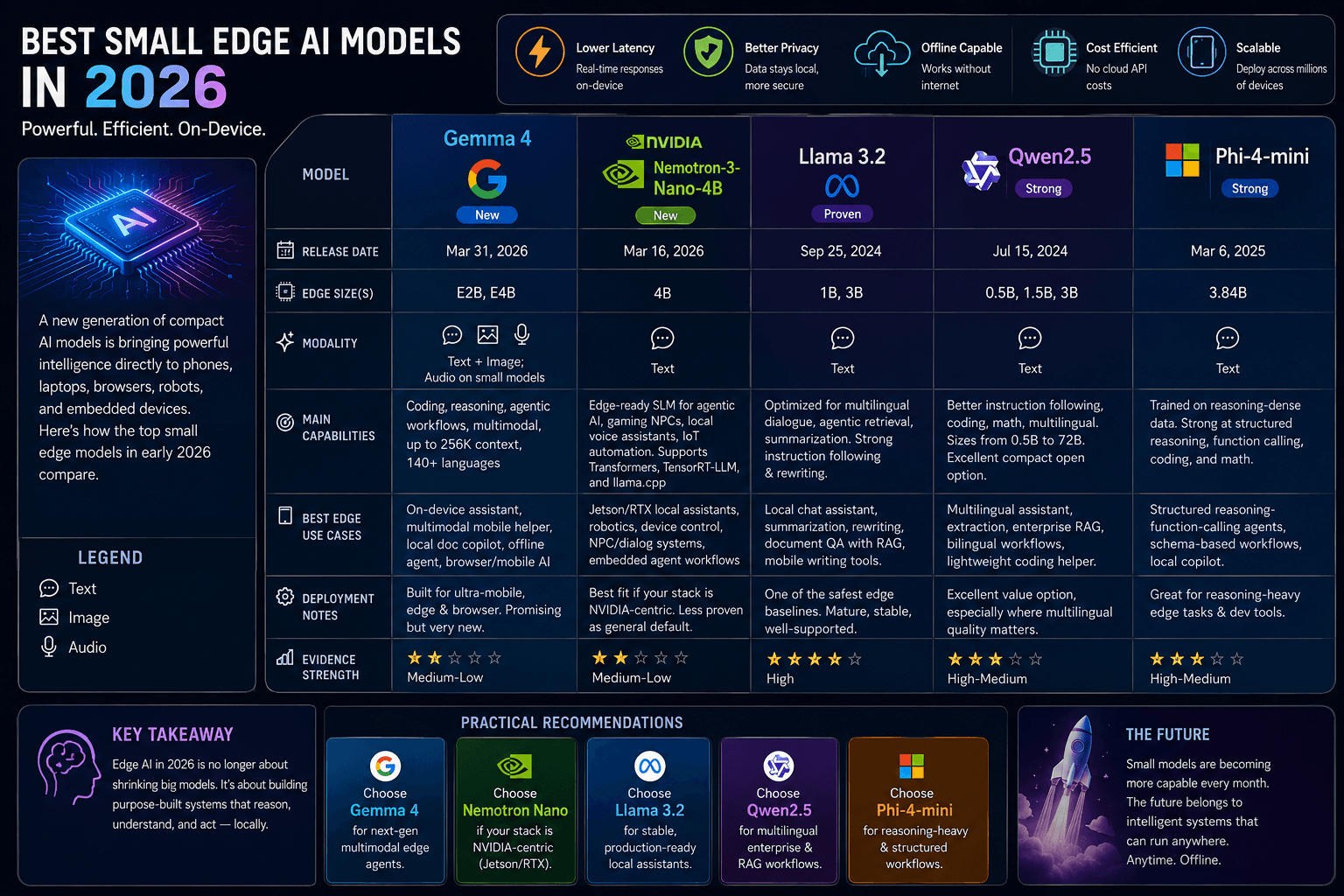
Small AI models are rapidly becoming the foundation of on-device intelligence. This deep dive explores Gemma 4, NVIDIA Nemotron Nano, Llama 3.2, Qwen2.5, and Phi-4-mini -comparing their real-world edge capabilities, deployment strengths, and future potential.
The AI industry is shifting from giant cloud-only models toward compact, highly capable edge AI systems. Instead of depending entirely on massive datacenter infrastructure, companies are now optimizing smaller models that can run directly on phones, laptops, browsers, robotics systems, and embedded hardware.
This transition is changing how AI products are designed. The focus is no longer only raw benchmark intelligence -efficiency, latency, multimodality, and deployment flexibility now matter just as much.
Why Small Models Matter
Large cloud-hosted models remain powerful, but they introduce cost, latency, privacy, and scalability challenges. Small edge models solve many of these problems by bringing intelligence directly onto devices.
- Lower inference latency
- Offline AI capabilities
- Better privacy and local execution
- Reduced cloud costs
- Scalable deployment across millions of devices
The New Wave of Edge Models
Early edge AI systems were heavily limited in reasoning quality and multimodal capability. But the latest generation of compact models is dramatically more capable.
In early 2026, several major releases changed the landscape entirely -especially Google's Gemma 4 family and NVIDIA's Nemotron Nano line.
Gemma 4: Google’s Most Ambitious Small Model Yet
Google officially released Gemma 4 on March 31, 2026 with multiple variants including E2B, E4B, 31B, and 26B A4B models. The E2B and E4B variants are specifically designed for edge and ultra-mobile deployment.
Unlike earlier lightweight models, Gemma 4 is positioned not merely as a compact chatbot, but as a reasoning-focused multimodal AI system capable of agentic workflows.
- Supports text and image across the family
- Audio support on smaller models
- Up to 256K context window
- 140+ language support
- Designed for phones, browsers, and laptops
- Optimized for agentic workflows
Why Gemma 4 Is Important
Gemma 4 represents a major shift in how Google approaches open compact AI. Previous small models focused mainly on lightweight chat or experimentation. Gemma 4 instead aims to deliver advanced reasoning and multimodal intelligence within a compact deployment footprint.
The most important implication is that edge AI is no longer limited to simplified assistants. It is moving toward fully capable local agents.
NVIDIA Nemotron-3-Nano-4B
NVIDIA introduced Nemotron-3-Nano-4B on March 16, 2026 as an edge-ready small language model focused specifically on agentic AI systems.
The model is deeply aligned with NVIDIA’s hardware ecosystem, including Jetson Thor, RTX systems, and DGX Spark infrastructure.
- Designed for edge AI deployment
- Strong NVIDIA ecosystem integration
- Supports TensorRT-LLM and llama.cpp
- Targets gaming NPCs and robotics
- Optimized for local voice assistants
- Strong fit for embedded workflows
The Important Trade-off
Nemotron appears highly optimized for NVIDIA-centered infrastructure, which is both a strength and limitation. If your edge stack already depends on Jetson or RTX hardware, Nemotron becomes extremely compelling. But for cross-device general deployment, broader ecosystem models may still be safer.
Llama 3.2 Still Matters
Even with the arrival of newer models, Llama 3.2 remains one of the safest and most production-proven compact AI families available today.
The 1B and 3B instruction-tuned variants are particularly valuable for summarization, rewriting, local assistants, and RAG-backed workflows.
Qwen2.5 and the Multilingual Advantage
Qwen2.5 remains one of the strongest multilingual compact models available. The 3B variant in particular has gained attention for balancing efficiency, multilingual quality, and coding performance.
- Strong multilingual reasoning
- Excellent bilingual support
- Efficient enterprise RAG
- Good compact coding capabilities
Phi-4-mini and Structured Reasoning
Microsoft’s Phi-4-mini takes a slightly different direction. Rather than focusing purely on generic conversation, it emphasizes reasoning-dense data, structured workflows, and compact coding assistance.
This makes Phi particularly valuable for schema-constrained workflows, function calling, mathematical reasoning, and local copilots.
The Updated Edge AI Comparison
| Model | Release | Edge Size | Modality | Best Use | Current Maturity |
|---|---|---|---|---|---|
| Gemma 4 | Mar 2026 | E2B / E4B | Text + Image + Audio | Multimodal agents | Emerging |
| Nemotron Nano | Mar 2026 | 4B | Text | NVIDIA edge AI | Emerging |
| Llama 3.2 | Sep 2024 | 1B / 3B | Text | General assistants | Very Mature |
| Qwen2.5 | Jul 2024 | 0.5B–3B | Text | Multilingual AI | Mature |
| Phi-4-mini | Mar 2025 | 3.84B | Text | Reasoning workflows | Mature |
What Actually Changed in 2026
The most important shift is that edge AI models are no longer merely compressed versions of larger systems. They are becoming purpose-built products designed specifically for local reasoning, multimodal interaction, and autonomous workflows.
Gemma 4 and Nemotron Nano signal a broader industry trend: AI companies are now competing directly for edge dominance.
Practical Recommendations
- Choose Llama 3.2 for stable local assistants
- Choose Qwen2.5 for multilingual enterprise workflows
- Choose Phi-4-mini for structured reasoning
- Choose Gemma 4 for next-gen multimodal edge agents
- Choose Nemotron Nano if your stack is NVIDIA-centric
Final Insight
The edge AI race is no longer about simply shrinking models. It is about building systems intelligent enough to operate independently on real-world devices. The winners will not necessarily be the largest models -they will be the most deployable.