Blog / Beyond Prompt Engineering: How We Used Supervised Fine-Tuning for Smarter Recommendations
Applied AI
Beyond Prompt Engineering: How We Used Supervised Fine-Tuning for Smarter Recommendations
30 January 2026
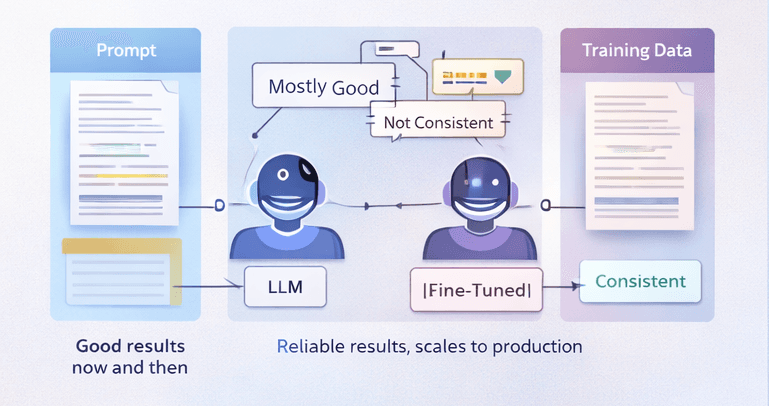
Prompt engineering can take AI systems surprisingly far-but it eventually hits a ceiling. This post explains why we moved beyond prompts and adopted supervised fine-tuning to build more reliable, scalable recommendation systems.
Large language models have made it possible to build intelligent systems with minimal setup. In the early stages of our recommendation engine, prompt engineering alone delivered impressive results, allowing us to prototype quickly and validate ideas.
However, as the system moved closer to production, we began to see clear limitations. Small prompt changes caused unpredictable behavior, responses lacked consistency, and performance varied significantly across similar user inputs.
Why Prompt Engineering Was Not Enough
Prompt-based systems rely heavily on the model’s general knowledge and reasoning ability. While this is powerful, it also means the model has no persistent understanding of our domain-specific goals, constraints, or success metrics.
As traffic increased and use cases expanded, maintaining hundreds of carefully tuned prompts became brittle and difficult to scale.
The Case for Supervised Fine-Tuning
Supervised fine-tuning offered a way to encode our expectations directly into the model. Instead of asking the model to infer our intent from prompts alone, we could explicitly teach it what good recommendations look like.
By training on labeled examples, the model learns patterns that prompts can only hint at-leading to more stable and predictable outputs.
Designing the Training Data
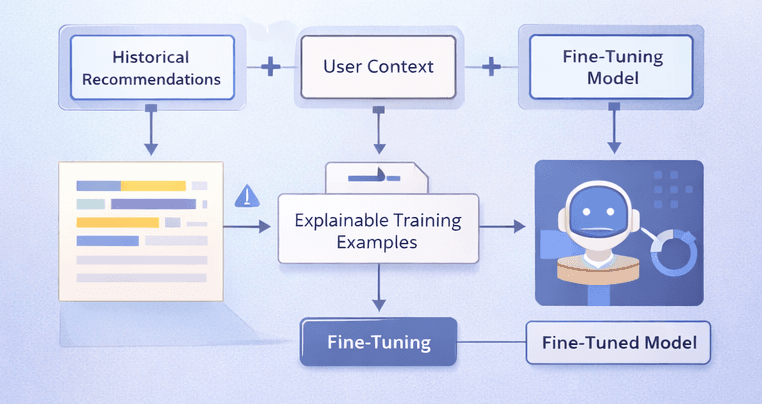
The most critical step was data curation. We constructed training examples from historical recommendation scenarios, pairing user context with high-quality, human-reviewed outputs.
Rather than optimizing for volume, we focused on clarity and correctness. Each example was designed to reflect real decision-making constraints and business logic.
Training the Model
We fine-tuned a base language model using supervised learning, ensuring that it consistently reproduced our preferred recommendation style across varied inputs.
This process reduced variance significantly. The model no longer relied on fragile phrasing tricks and instead internalized the structure of high-quality recommendations.
Combining Fine-Tuning with Prompts
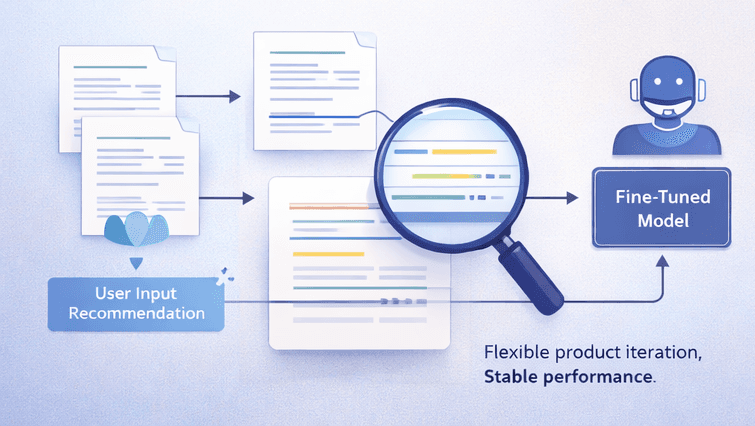
Fine-tuning did not eliminate the need for prompts-it changed their role. Prompts became lightweight configuration tools rather than the primary mechanism for controlling behavior.
This separation allowed us to iterate on product features without constantly re-engineering prompts.
Measuring the Impact
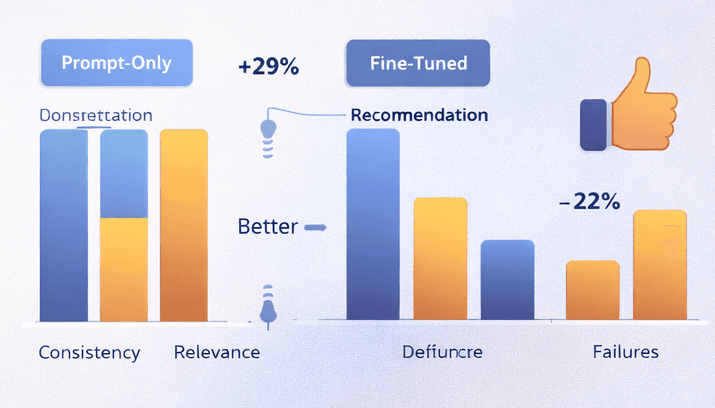
We evaluated the system using both offline benchmarks and live experiments. Fine-tuned models showed higher consistency, improved relevance, and fewer failure cases compared to prompt-only approaches.
Equally important, the system became easier to debug and maintain, since behavior was learned rather than implicitly encoded in prompts.
Lessons Learned
Prompt engineering is an excellent starting point, but it is not a long-term substitute for training. When product requirements stabilize and quality becomes critical, fine-tuning provides a more robust foundation.
The key insight is not choosing between prompts and training-but understanding when to transition from one to the other.
Closing Thoughts
Building reliable AI systems requires moving beyond clever prompting toward models that truly understand the task they are solving.
Supervised fine-tuning allowed us to scale recommendations with confidence, turning experimental AI behavior into a production-ready system.