Blog / Context Graphs: Teaching AI How Work Actually Happens
AI Infrastructure
Context Graphs: Teaching AI How Work Actually Happens
3 February 2026
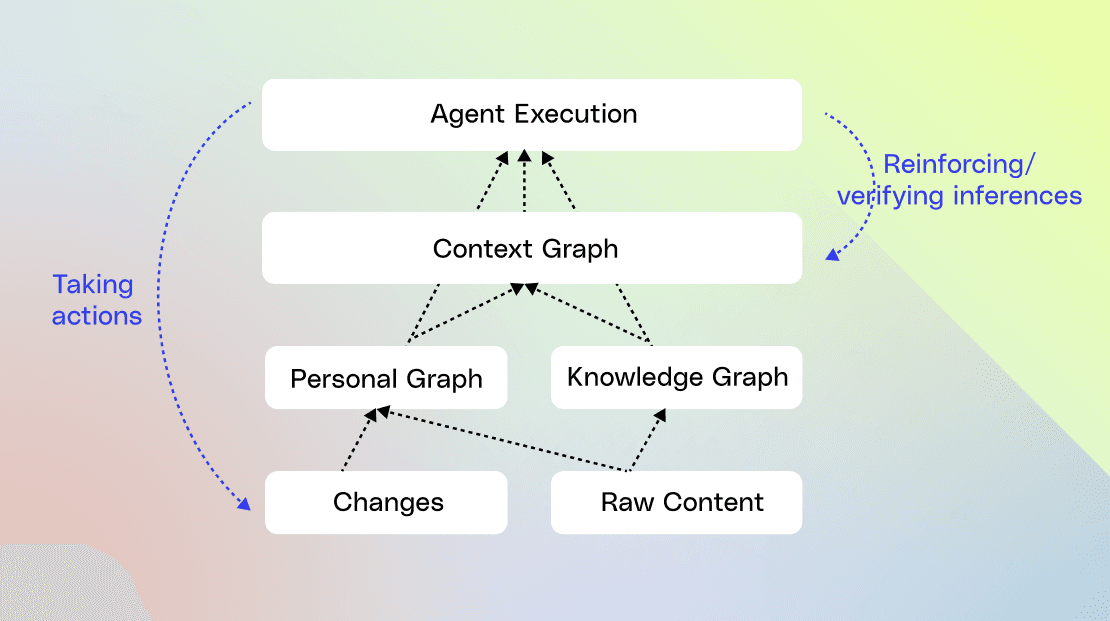
Context graphs connect enterprise entities with real action traces to help AI understand how work actually gets done. By modeling behavior instead of just data, context graphs enable agents to reason over real processes, adapt to change, and automate complex workflows reliably.
Context graphs are gaining significant attention, with some investors calling them a trillion-dollar opportunity. This excitement reflects a growing realization: while AI systems can now call tools and take actions, they still lack an understanding of how work actually happens inside organizations.
Most enterprise systems are designed to capture static entities like documents, tickets, customers, and dashboards. However, real work happens between these records-in conversations, meetings, emails, comments, and informal handoffs. Without modeling these flows, AI cannot reliably automate business processes.
Context graphs aim to bridge this gap by modeling not just what exists, but how change happens across people, tools, and time. This post explains what context graphs are, why they matter, and how they can be built to support long-running, adaptive AI agents.
What Is a Context Graph?
A context graph is a model that connects enterprise entities-such as people, documents, tickets, systems, and customers-with the actions and events that occur between them over time. It captures the real execution of work, not just its outcomes.
By modeling action traces, context graphs allow AI systems to understand how work actually unfolds. This enables AI to answer questions about typical workflows, common deviations, and the intent behind different paths.
Why Traditional Systems Fall Short
Systems of record are effective at capturing decisions and current state, but they rarely capture execution variability. They often miss the conversations, investigations, and intermediate steps that explain why a particular outcome occurred.
Relying only on these systems can lead to blind spots. AI agents built on incomplete data may follow rigid workflows that do not reflect how work is actually done, resulting in suboptimal or brittle automation.
From Modeling What Exists to Modeling How Work Flows
Traditional enterprise data models focus on static objects such as customers, documents, and tickets. Context graphs instead focus on behavior-who did what, in which tool, at what time, and with what downstream effect.
In a context graph, actions become first-class entities. Each meaningful action is represented as a node with timestamps and metadata, while edges capture causal and correlational relationships between actions.
This structure enables the system to learn probabilistic paths rather than rigid workflows, allowing agents to predict what is likely to happen next without hard-coding process logic.
Learning From Human and Agent Behavior
When AI agents execute tasks within the system, their actions are added back into the context graph as new traces. These traces are evaluated to determine whether the chosen paths were effective and where improvements are possible.
Successful executions reinforce preferred patterns, while failures highlight areas where additional context or better tool usage is needed. Over time, the graph evolves into a shared model of human and agent behavior.
Deep Integrations and Observability
Building a context graph requires deep integrations with the tools where work actually happens, including chat, documents, email, calendars, CRM systems, ticketing tools, code repositories, dashboards, and internal applications.
These integrations capture not only content but also change events, which are normalized into action traces. Maintaining this foundation requires reconciling identities, handling inconsistent APIs, and continuously enforcing permissions.
Building the Knowledge Graph
After data is ingested, a machine learning pipeline infers higher-level entities such as projects, customers, products, teams, and people. Relationships between these entities and artifacts like tickets, documents, and dashboards are identified.
Activity signals such as views, edits, and comments are layered on top to understand how information is actually used. Knowledge graphs provide the structure needed to interpret noisy activity data meaningfully.
Building the Personal Graph
In parallel, a personal graph is created for each individual. This graph captures a chronological sequence of actions across tools, enriched with metadata from the knowledge graph.
Because real work is messy, the system combines lightweight heuristics with language models to group low-level actions into coherent tasks and projects. Personal graph data remains private and is only analyzed in aggregate.
Creating the Context Graph
To construct the context graph, personal graphs are normalized into anonymized process traces. These traces include action types, tool categories, involved entities, derived process tags, and timing and outcome signals.
Raw content, user identifiers, and sensitive data are excluded. Only patterns that appear across multiple users and traces are retained, ensuring privacy while enabling meaningful insights.
Representing Process Data Effectively
Pure graph structures are rigid, while raw text is difficult to traverse. A hybrid approach is used that breaks text into smaller segments, tags them with entity identifiers, and embeds them for navigation.
This allows agents to follow processes step by step using clear guideposts, even in complex workflows like incident response or deal negotiation.
Closing the Loop With Agent Execution
When agents operate within the context graph, every execution becomes a new trace. These traces record tool usage, action order, outcomes, and user feedback.
Offline evaluation explores alternative paths, reinforcing effective strategies and identifying anti-patterns. Over time, the graph becomes a living model of shared human and agent workflows.
Why Context and Orchestration Must Stay Together
Separating the context graph from agent orchestration leads to drift. Keeping both within the same system ensures agents remain grounded in an up-to-date representation of how work actually happens.
Building Context Graphs in Practice
Before fully committing, Cognoai tested context graphs internally by analyzing anonymized personal graph data. This revealed repeated, high-value processes such as sales cycles, incident response, and product launches.
Rather than producing static agents, the goal was to build a system that continuously learns from new traces. As processes evolve, ownership changes, and tools shift, the context graph adapts alongside them.
This approach enables long-running, autonomous agents that remain aligned with real organizational workflows-bringing AI closer to reliably automating meaningful work.