Blog / LangExtract: Turning Unstructured Text into Structured, Auditable Data
AI Tools
LangExtract: Turning Unstructured Text into Structured, Auditable Data
10 December 2025
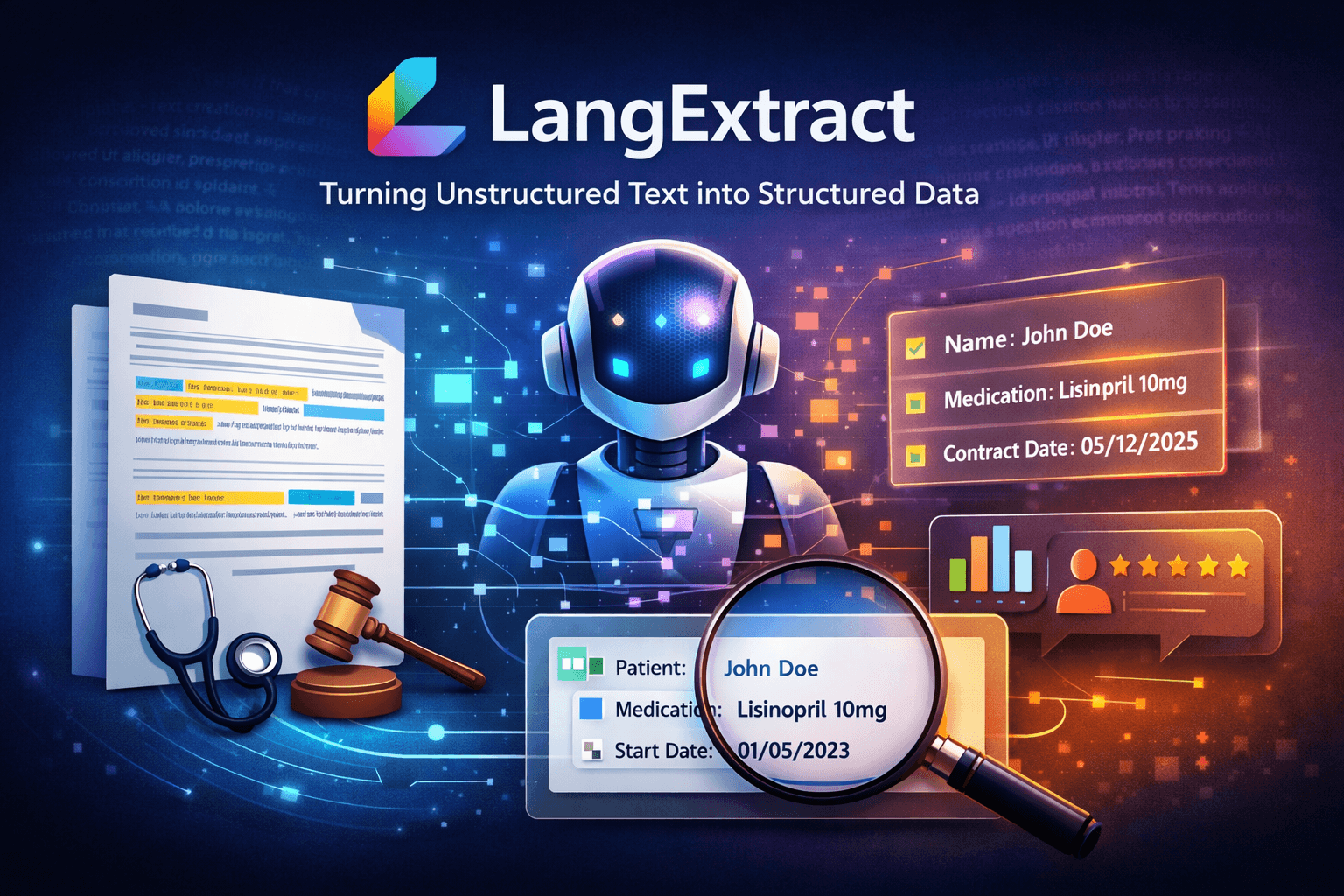
Extracting structured information from raw text has long been fragile and labor-intensive. LangExtract introduces a prompt-driven, model-powered approach that converts unstructured text into reliable, source-grounded data at scale.
Unstructured text dominates real-world data. Clinical notes, contracts, customer feedback, and research documents all contain critical information, yet extracting that information reliably has traditionally required complex rules or extensive manual labeling.
As large language models have improved, they offer a new path forward-but only if their outputs can be made consistent, interpretable, and trustworthy. LangExtract was created to address exactly this gap.
What Is LangExtract?
LangExtract is an open-source Python library designed for structured information extraction using large language models. Instead of writing brittle parsing logic, developers define what to extract using natural language prompts and a small number of examples.
The library then produces structured outputs that are explicitly linked back to the original text, making every extracted value traceable and auditable.
Why Traditional Extraction Pipelines Fall Short
Rule-based systems struggle with linguistic variation, ambiguity, and scale. Even minor changes in wording can break extraction logic, leading to silent failures that are difficult to detect.
Manual annotation pipelines improve accuracy but are expensive to maintain and slow to adapt when requirements change. These limitations make traditional approaches poorly suited for dynamic, real-world text.
Prompt-Driven Extraction Instead of Rules
LangExtract replaces rigid rules with prompt-based specifications. Developers describe the desired fields, provide a few representative examples, and allow the model to generalize across diverse text inputs.
This approach dramatically reduces development time while remaining flexible enough to adapt to new document formats or domains.
Grounding Outputs in the Source Text
A core design principle of LangExtract is grounding. Every extracted entity is associated with its exact span in the source document, ensuring transparency and enabling downstream validation.
This grounding is especially important in regulated environments where understanding the provenance of data is just as critical as the data itself.
Designed for Long and Complex Documents
Real-world documents are often long, messy, and inconsistent. LangExtract handles this by chunking text, running multiple extraction passes, and merging results to avoid missing relevant information.
This allows the system to scale gracefully from short notes to multi-page reports without sacrificing accuracy.
Flexible Model Support
LangExtract is model-agnostic. It can work with hosted models such as Gemini as well as local or self-hosted LLMs, giving teams control over performance, privacy, and cost.
This flexibility makes it suitable for both experimentation and production deployment across a wide range of environments.
Real-World Applications
In healthcare, LangExtract can identify medications, dosages, and symptoms from clinical notes. In legal workflows, it can extract clauses, obligations, and timelines from contracts.
Business teams can use it to structure customer feedback, while researchers can analyze entities and relationships in large text corpora.
Why Auditability Matters
LLM-powered systems are often criticized for behaving like black boxes. LangExtract directly addresses this concern by making extraction results inspectable and traceable.
When errors occur, developers can see exactly which part of the text caused the issue and refine prompts accordingly, creating a tight feedback loop for improvement.
Implications for AI Builders
LangExtract demonstrates that reliable information extraction does not require complex training pipelines or massive labeled datasets. Instead, carefully designed prompts and grounded outputs can achieve both flexibility and trust.
For teams building AI-driven products, this approach offers a practical way to move faster without sacrificing correctness.
Closing Thoughts
As language models continue to evolve, the challenge shifts from generating text to controlling and validating it. LangExtract represents an important step toward making LLM outputs usable in real systems.
By combining prompt-driven extraction with explicit grounding in source text, LangExtract turns unstructured data into something developers can finally trust.