Blog / Practical AI Agent Evaluation
AI Evaluation
Practical AI Agent Evaluation
21 January 2026
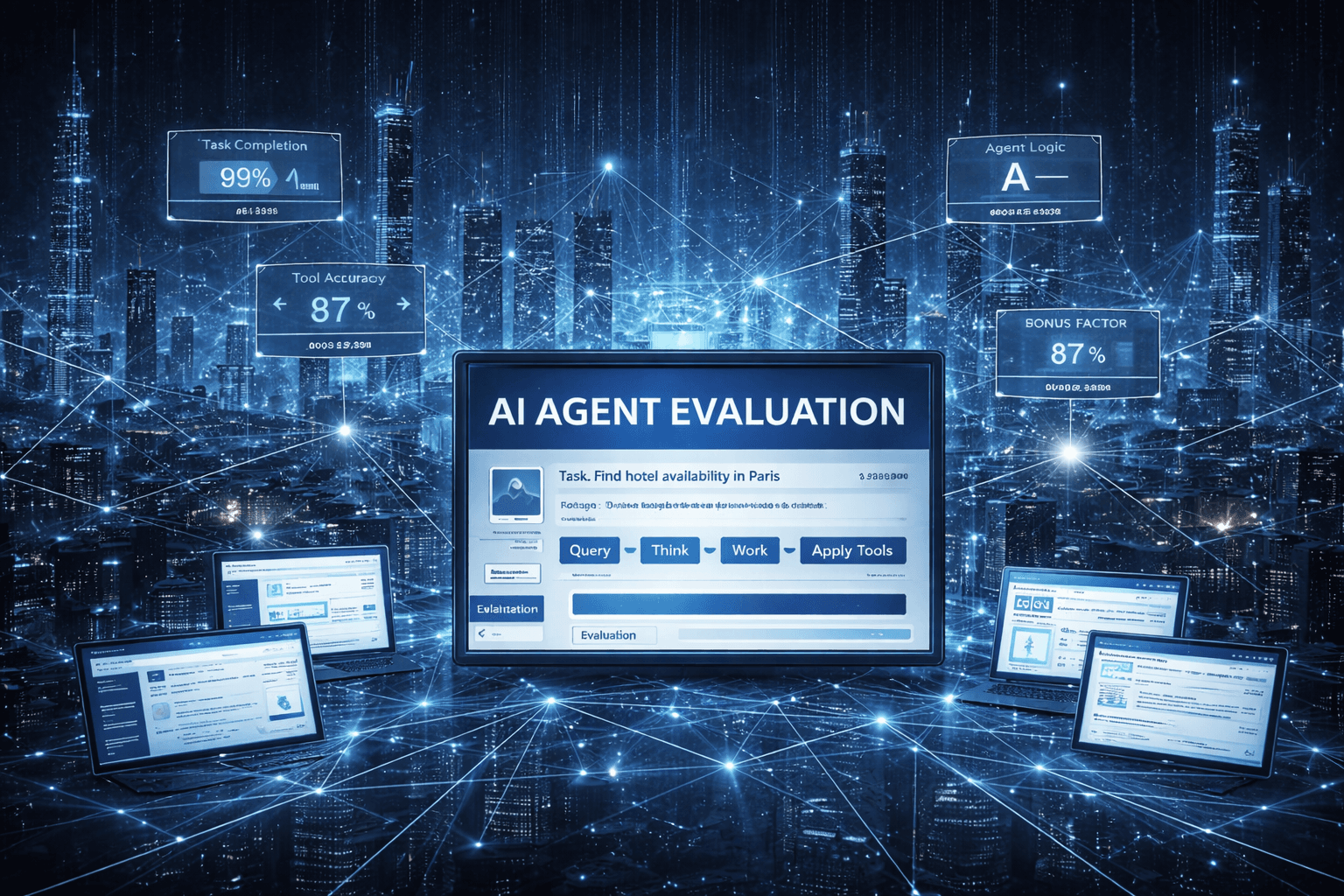
Evaluating AI agents is very different from evaluating standalone LLMs. At , agent evaluation is approached systematically to measure how reliably and efficiently agents complete tasks, reason and use external tools. This blog breaks down balanced, practical tips for evaluating autonomous systems in real scenarios.
AI agents are advanced systems powered by large language models that can reason, act and interact with tools to solve complex tasks without direct human prompts. Unlike traditional LLMs that simply respond to individual queries, agents plan, choose tools, observe results and adapt until they achieve a goal. This flexibility enables powerful capabilities, but also introduces challenges for measuring performance effectively.
Two Ways to Evaluate Agents
uses two complementary approaches to evaluate agent behaviour, each with a different purpose and depth of insight.
- Black-box evaluation considers only the agent’s input and final output, treating the agent as a closed system - similar to how an end user experiences it.
- Glass-box evaluation digs into the intermediate reasoning steps and actions, helping to understand *how* the agent arrived at its results.
Black-box focuses on what the agent produces, while glass-box reveals *why* and *how* it behaved in a certain way, including mistakes in reasoning or tool use.
Measuring Task Completion
One core metric in black-box evaluation is task completion - whether an agent successfully fulfils the request it was given. At , this is often determined using another LLM as a judge, which reviews the agent’s entire conversation and outcome to decide if the requested tasks were handled correctly.
Understanding Internal Actions
Glass-box evaluation looks inside the agent’s internal decisions, especially how it chooses and calls tools. This helps reveal *where* the agent may struggle - such as calling the wrong API, providing incorrect parameters, or misunderstanding the context.
- Tool call validity - was the tool call formatted and executed correctly?
- Tool correctness - was the most appropriate tool chosen for the task?
- Argument accuracy - were parameter values correct and relevant to the context?
Breaking down tool interactions helps teams pinpoint flaws in the agent’s decision-making and refine both its reasoning and tool-calling logic.
Benchmarking Agents Against Baselines
Before trusting an agent in production, it’s important to benchmark its performance against simpler alternatives. At , teams compare agents against a range of baselines - from rule-based approaches to prompt-only LLM setups - to verify that the added complexity truly delivers better outcomes.
What Evaluation Reveals
A thoughtful evaluation framework doesn’t just tell you *if* an agent works - it also shows *how* and *why* it succeeds or fails. For example, internal analysis can expose inconsistencies in reasoning, misunderstandings of user intent, or inefficiencies in tool usage.
By combining black-box and glass-box insights, teams can improve agent precision, reliability and trustworthiness over time - ensuring agents not only complete tasks but do so in ways that align with product goals and performance requirements.
Putting It All Together
Evaluating AI agents is more than simply measuring their final outputs. It requires understanding both what the agent delivers and how it makes decisions along the way. By adopting structured evaluation practices - including using judge models, dissecting tool usage, and comparing against baseline systems - you can confidently assess and improve agent quality.