Foundation Models
CognoAI integrates seamlessly with leading AI models across the ecosystem, spanning both open-source and proprietary technologies. This includes powerful platforms from companies like Google and Meta, as well as other cutting-edge providers. By supporting a wide range of models, CognoAI ensures flexibility and freedom of choice, allowing organizations to select the best tools for their specific needs.
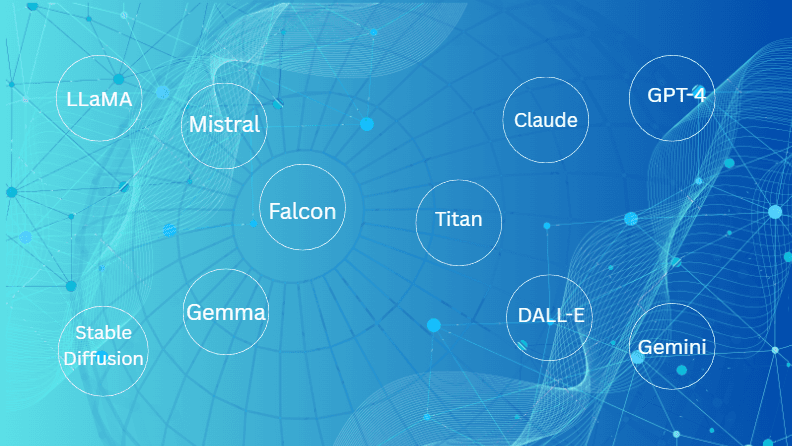
CognoAI integrates seamlessly with leading AI models across the ecosystem, spanning both open-source and proprietary technologies. This includes powerful platforms from companies like Google and Meta, as well as other cutting-edge providers. By supporting a wide range of models, CognoAI ensures flexibility and freedom of choice, allowing organizations to select the best tools for their specific needs.Rather than locking you into a single vendor, CognoAI enables a unified architecture where multiple models can work together efficiently. This approach allows teams to leverage the strengths of different models-whether it’s advanced language understanding, computer vision, or domain-specific capabilities-without compromising on performance or scalability.The platform is designed to simplify integration, reduce complexity, and accelerate deployment, making it easier to experiment, compare, and optimize across different AI providers. It also ensures enterprise-grade reliability, security, and governance across all integrations.By bridging the gap between diverse AI technologies, CognoAI empowers organizations to build robust, future-proof AI systems that evolve alongside the rapidly changing AI landscape, ensuring long-term value and adaptability.
The Foundation Models Behind CognoAI
CognoAI integrates with a wide range of leading foundation models-from closed-source frontier systems to powerful open-source alternatives-so teams can pick the right model for each use case.
OpenAI GPT-4o(Proprietary)
GPT-4o is OpenAI’s flagship multimodal model that can process text, images, and audio and generate text, images, and audio outputs in a single system. It is widely used for coding assistance, complex reasoning, and conversational agents due to its strong performance across standard benchmarks.
Anthropic Claude 3.5 Sonnet(Proprietary)
Claude 3.5 Sonnet is a frontier model from Anthropic focused on reliability, long-context reasoning, and safe deployment. It performs strongly on reasoning and knowledge-intensive tasks and is frequently chosen for enterprise-grade assistants and document-heavy workflows.
Google Gemini 2.0(Proprietary)
Gemini 2.0 is Google’s multimodal model line, tightly integrated into the Google ecosystem and Vertex AI. It supports very large context windows, native tool calling, and real-time information integration, making it suitable for complex agentic workflows and search-style applications.
Google Gemma / Gemma 3(Open Source)
Gemma is Google’s lighter-weight open model family built on Gemini technology. Gemma 3 models are multimodal, support context windows up to around 128K tokens, and are optimized for deployment on resource-constrained environments while retaining strong multilingual performance.
Meta Llama 3 / 3.1(Open Source)
Llama 3 and 3.1 are Meta’s open foundation models that power much of the open-source ecosystem, ranging from small 8B variants to a ~405B flagship model, with strong chat, coding, and multilingual capabilities.
DeepSeek-V3(Open Source)
DeepSeek-V3 is a large open-source Mixture-of-Experts model with about 671B total parameters and ~37B active parameters per token. It is positioned as a competitive alternative to top closed models like GPT-4o and Claude.
DeepSeek-R1(Open Source)
DeepSeek-R1 is a reasoning-oriented open model targeting performance comparable to OpenAI’s reasoning-focused models, offering advanced reasoning with greater deployment and cost control.
Mistral Large 2 & Mixtral 8x7B(Hybrid)
Mistral Large 2 is a strong proprietary model, while Mixtral 8x7B is an open Mixture-of-Experts model offering GPT-3.5-class performance at lower cost with support for customization and on-premise deployment.
Alibaba Qwen 2.5 / Qwen3(Open Source)
Qwen 2.5 and Qwen3 are multilingual foundation models from Alibaba that perform strongly on reasoning, coding, and non-English language tasks, with context windows up to 128K tokens or more.
01-AI Yi-34B(Open Source)
Yi-34B is a 34B-parameter open foundation model trained on about 3.1T tokens, balancing cost and performance and matching or exceeding GPT-3.5 on many benchmarks.
Amazon Nova / Bedrock Models(Proprietary)
Amazon Nova Pro and related models are part of Amazon’s foundation model offerings via Bedrock, tightly integrated with AWS services and designed for compliance, data residency, and AWS-native workflows.
Falcon 180B(Open Source)
Falcon 180B is a 180-billion-parameter open model that marked an early milestone in large-scale open-source LLMs and remains relevant for research and fine-tuning workflows.
When to Use Which Models
- Use frontier proprietary models (GPT-4o, Claude, Gemini) when maximum quality or advanced multimodal reasoning is required.
- Deploy open models such as Llama 3, DeepSeek-V3, Qwen, Yi, and Mixtral when on-premise control, fine-tuning, or lower inference cost is a priority.